
Squadron operations · Artificial intelligence · U.S. Naval Aviation
Fly more. Spreadsheet less.
Ops Buddy gives the ready room its time back. Scheduling, qualifications, currency, training, and the readiness cycle are one connected system. Instead of dozens of people and disconnected spreadsheets, Ops Buddy combines these processes using automation and AI in a user-friendly, customizable application.
- Built by a former fleet naval aviator
- NATOPS and CNAF M-3710.7 rules enforced on every name
- AI answers that cite the instruction
- Prototyped for the MQ-4C Triton, customizable to any T/M/S
Demonstration data — fictional squadron, crews and aircraft
Ops Buddy
VUP-99 · MQ-4C TRITON
0450LT D. Iverson — IMSAFE — fatigue
Aircraft Commander on ORBIT ALPHA · 169XXX · 0630 takeoff. Two hours to launch.
Legal for this event · ranked by cost to the plan
- 1
LCDR T. AlvaradoPilotRecommended
AC qualified, all currencies green. Off watch since 1900, 11h 30m rest.
Cost — No second-order effect. Ground slot at 0900 moves to Boateng.
- 2
LT N. BoatengAVO
AC qualified, all currencies green. No conflicting assignment.
Cost — Pulls him off INST-2 in TOFT 1. Sim reschedules to Thursday.
- 3
LCDR H. SandovalNATOPS Officer
AC qualified, all currencies green. Currently unassigned.
Cost — Delays two jacket reviews ahead of the FNE.
Blocked by the rules engine
- LTJG R. CastellanosPilotInstrument check expired 14 JUL 2026
- LT S. MarchettiAVONot AC qualified — upgrade in progress
- LT J. KowalskiMPOCrew rest — landed 0230, 4h 20m
“Can I put him in that seat?”
Not if his NATOPS is down. The board refuses the assignment, says why on the tile, and offers who to pick instead — ranked by what it costs the plan.
“The sim just went down.”
Tonight rebuilt automatically — with the knock-on effects on ARP, ORE and every upgrade timeline computed, not discovered next month.
“My AC just called IMSAFE.”
Ranked replacements who are actually qualified, current, medically up, rested and available. Seconds, not a scramble.
“The FNE is in six weeks.”
Every jacket already audited against the standard, continuously. Walk in knowing what the evaluator will find.
Two Products
The whole platform, or just the NATOPS portion.
Ops Buddy is a working prototype built for the MQ-4C Triton community, and it can be customized to any community in naval aviation. The Navy’s first unmanned squadron should run on future technology — not paper jackets and whiteboards. One codebase serves both products, so starting with the narrower one is a step toward the wider one rather than a detour.
Ops Buddy
Scheduling and operationsThe whole platform. Scheduling, operations and NATOPS in one system, configurable to every T/M/S and to the way your squadron actually builds a schedule. Includes everything in NATOPS Buddy.
- Daily and long-range scheduling, rule-checked on every name
- Configurable per T/M/S and per squadron
- Readiness cycle, syllabus and upgrade progression
- Stress testing, disruption recovery and rapid safe swap
- Everything in NATOPS Buddy, included
NATOPS Buddy
The NATOPS section, standaloneThe NATOPS portion of Ops Buddy on its own — the jacket, the matrix, currency and the Fleet NATOPS Evaluation. Built to carry most of what a NATOPS track lead does by hand today.
- Digital NATOPS jackets and the squadron qualification matrix
- Upload a document — an upshot, a completed check form — and it reads what it is and updates the tracker and the matrix
- Auto-fills the /2 and /7 instrument and NATOPS check forms
- Interfaces with the logbook
- Synchronises with SHARP over its API, so jackets are digitised rather than re-keyed
In active development. The capabilities described here sit at varying stages of maturity.
The Product
Build it once. Correctly.
It starts with the board — the magnet tiles off the operations whiteboard, with every rule that used to live in somebody’s head enforced on every name. Then it answers the questions that used to cost an afternoon. Eleven of them below, running in this page against a fictional squadron, in the product’s own layout.
Pick a question
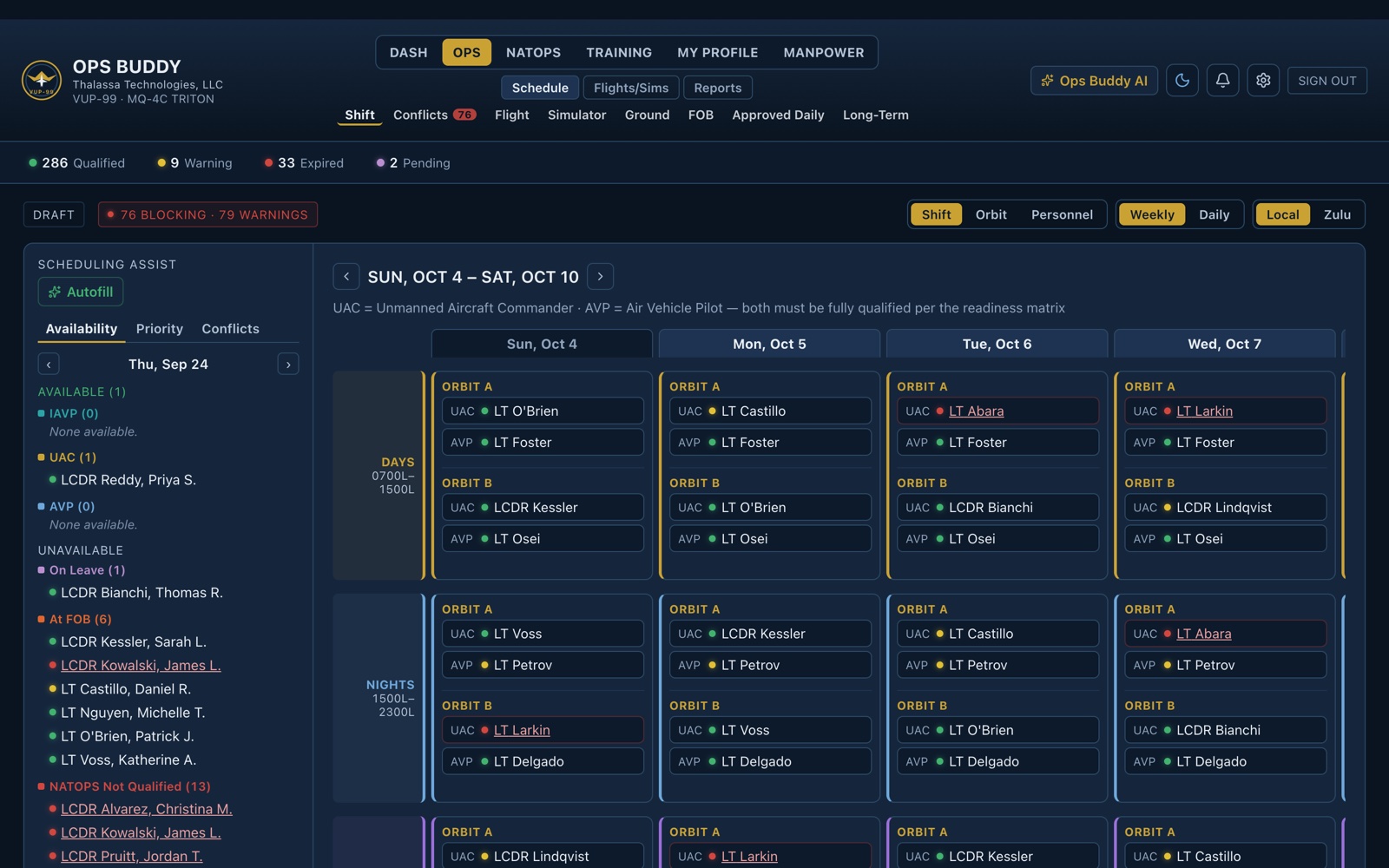
“Who am I allowed to put in this seat?”
The real shift board — the week of 4 October, three shifts by two orbits, UAC and AVP seats as magnet tiles. The sidebar has already sorted the squadron into available, unavailable and not qualified, in red, before anyone is placed; the Autofill button fills what is open from the ranked recommendations.
Demonstration data — fictional squadron, crews and aircraft
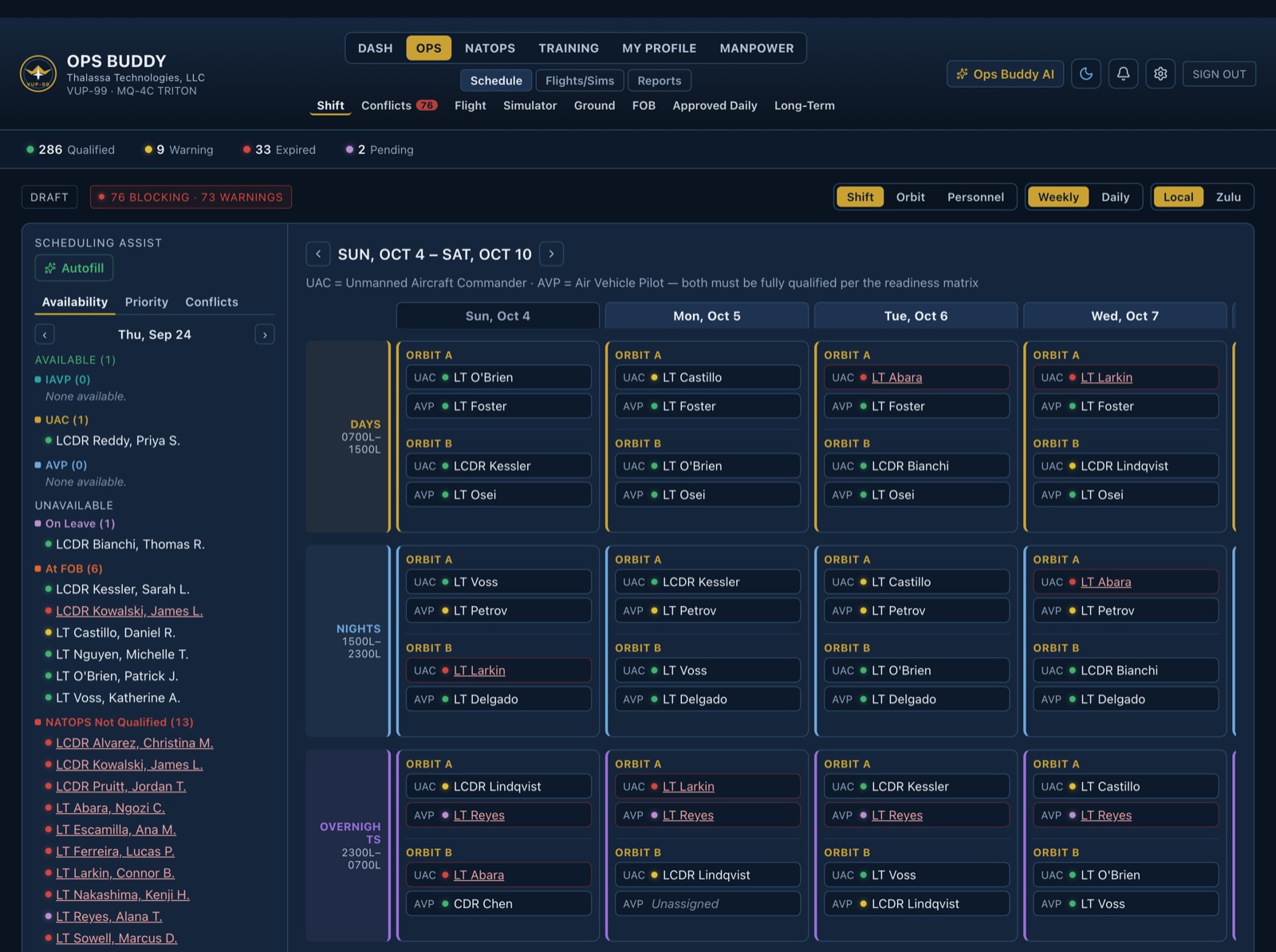
“Fill the open seats — legally.”
One press. Every open seat for the week is filled from the ranked recommendations — qualification, currency, medical status, crew rest and the command’s own rules checked on each name — and the board stays a draft until a scheduler approves it. This is the same week as the board above, after the button.
Demonstration data — fictional squadron, crews and aircraft
“My AC just called IMSAFE. Who can fill in?”
Two hours to launch. The system answers with people who are actually qualified, current, medically up, rested and available — because it already knows all five — and says what each swap costs the rest of the plan. Making this instant is what removes the quiet pressure not to make the call.
Demonstration data — fictional squadron, crews and aircraft
Ops Buddy
VUP-99 · MQ-4C TRITON
0450LT D. Iverson — IMSAFE — fatigue
Aircraft Commander on ORBIT ALPHA · 169XXX · 0630 takeoff. Two hours to launch.
Legal for this event · ranked by cost to the plan
- 1
LCDR T. AlvaradoPilotRecommended
AC qualified, all currencies green. Off watch since 1900, 11h 30m rest.
Cost — No second-order effect. Ground slot at 0900 moves to Boateng.
- 2
LT N. BoatengAVO
AC qualified, all currencies green. No conflicting assignment.
Cost — Pulls him off INST-2 in TOFT 1. Sim reschedules to Thursday.
- 3
LCDR H. SandovalNATOPS Officer
AC qualified, all currencies green. Currently unassigned.
Cost — Delays two jacket reviews ahead of the FNE.
Blocked by the rules engine
- LTJG R. CastellanosPilotInstrument check expired 14 JUL 2026
- LT S. MarchettiAVONot AC qualified — upgrade in progress
- LT J. KowalskiMPOCrew rest — landed 0230, 4h 20m
“The sim went down. What breaks?”
A broken simulator is a small event; its consequences are not. The effects on ARP, ORE and every upgrade timeline are computed the moment the event is cancelled, and the rebuild options are ranked by what they cost the plan — rather than bridged by a person with a spreadsheet and an afternoon.
Demonstration data — fictional squadron, crews and aircraft
Ops Buddy
VUP-99 · MQ-4C TRITON
1418TOFT 2 down for unscheduled maintenance
2 events cancelled: NATOPS CK (1400–1730), EMER-7 (Tomorrow 0800–1130).
Second- and third-order effects · computed
ARPNo impact
Simulator events this period drop to 60 of 64. Still inside tolerance.
ORE milestoneWatch
Crew certification event on 14 OCT at risk if TOFT 2 is down more than four days.
Upgrade timelineWatch
LTJG Petrov’s AC upgrade slips two weeks unless NATOPS CK is re-flown by 19 SEP.
CurrencyNo impact
LCDR Sandoval’s instrument currency lapses 28 JAN 2027. No near-term exposure.
Rebuild options · cheapest change first
- 1
Move both events to TOFT 1Recommended
TOFT 1 has 1730–2030 open tonight and 1130–1430 tomorrow. Both crews are available and rested for those windows.
Cost — Nothing else moves. ORE milestone protected.
- 2
Re-fly NATOPS CK Thursday, hold EMER-7
Keeps TOFT 1 free for the FAM syllabus. Petrov’s upgrade stays on timeline.
Cost — EMER-7 slips a week. ARP drops to 58 of 64.
- 3
Convert NATOPS CK to an aircraft event
169XXX is up and unassigned tomorrow. Requires an instructor and burns 3.2 flight hours.
Cost — Flight hours against the monthly allocation. Upgrade timeline held.
“The evaluation is in six weeks. What will they find?”
Unit NATOPS evaluations run on an 18-month cycle and the evaluator reviews the records directly. Every jacket is audited continuously against the standard, so the squadron walks in already knowing every discrepancy — and so does the day go differently for the FRS evaluator.
Demonstration data — fictional squadron, crews and aircraft
Ops Buddy
VUP-99 · MQ-4C TRITON
14 OCT 2026
Evaluation date
42
Days out
29/34
Jackets clean
5
Open findings
Continuous audit against the standard
LT D. IversonII-A · NATOPS EvaluationDiscrepancy
Evaluation expired 02 AUG 2026. No extension request on file.
LTJG R. CastellanosIII-E · Instrument RatingDiscrepancy
Instrument check expired 14 JUL 2026. Flown but not signed.
LT J. KowalskiI-D · Flight Equipment IssueAdministrative
Issue record not updated after the July gear refit.
LT S. MarchettiII-C · CRMAdministrative
CRM refresher date recorded, instructor signature block blank.
LTJG E. PetrovIV-A · Flight LogAdministrative
Two sorties in June missing TFT entries.
Findings update as records change. Nothing here was compiled for a meeting.
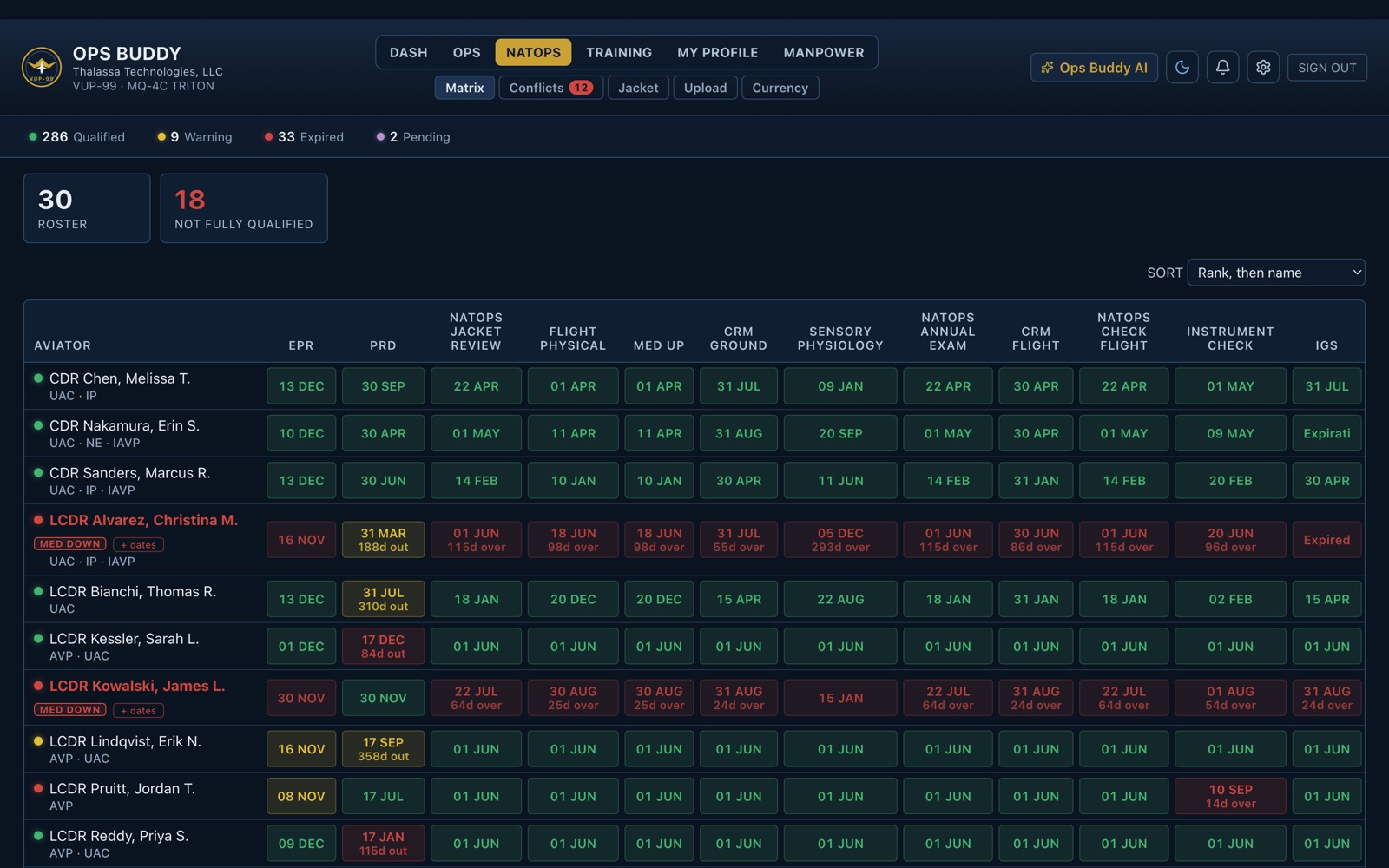
“Who is legal to fly tomorrow?”
The squadron qualification matrix as the app draws it — every aviator against every currency in the fleet’s four colours, a legend of the counts across the top, and the aviator whose NATOPS check is inside the window carrying the amber cell.
Demonstration data — fictional squadron, crews and aircraft
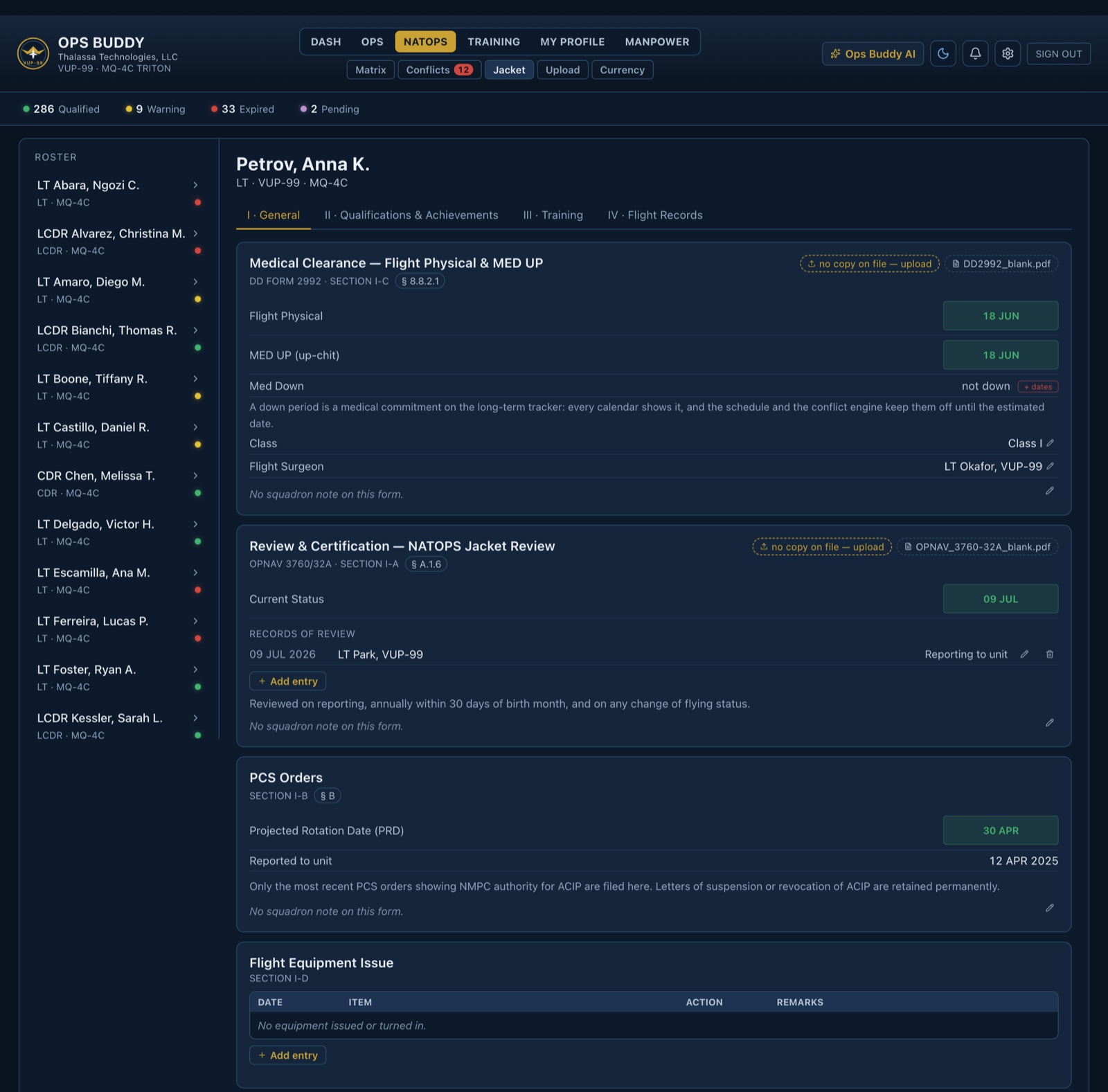
“What does the record actually say?”
The NATOPS jacket, digital, laid out the way OPNAV 3760/32 lays it out — sections in the form’s own order, each with its record tables, and a document chip for the signed form.
Demonstration data — fictional squadron, crews and aircraft
“What does the next six months look like?”
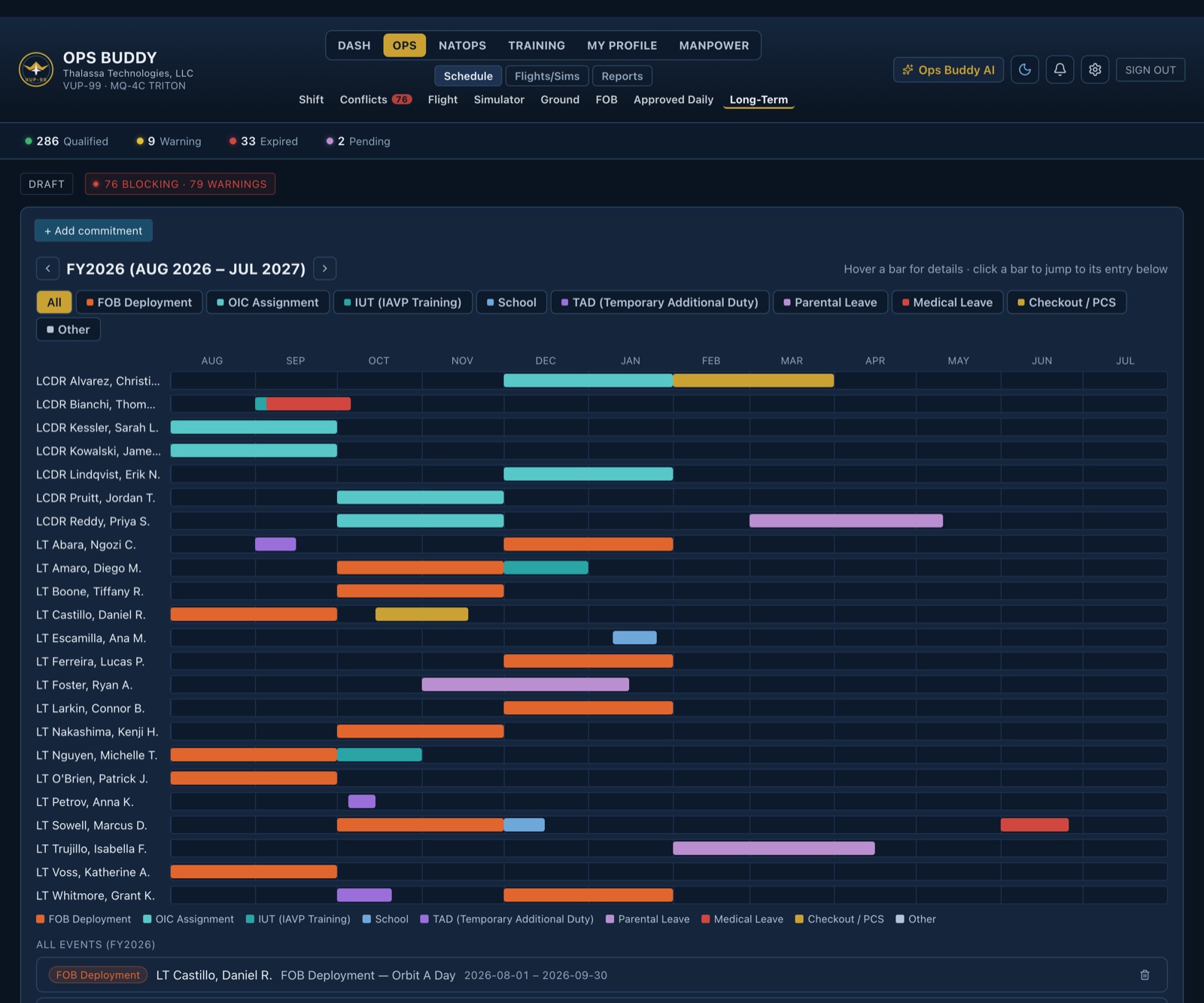
The long-term plan: schools, TAD, leave, IUT and detachments for the whole squadron on one axis, with the manning consequence drawn underneath.
Demonstration data — fictional squadron, crews and aircraft
“Do I have enough aircraft commanders?”
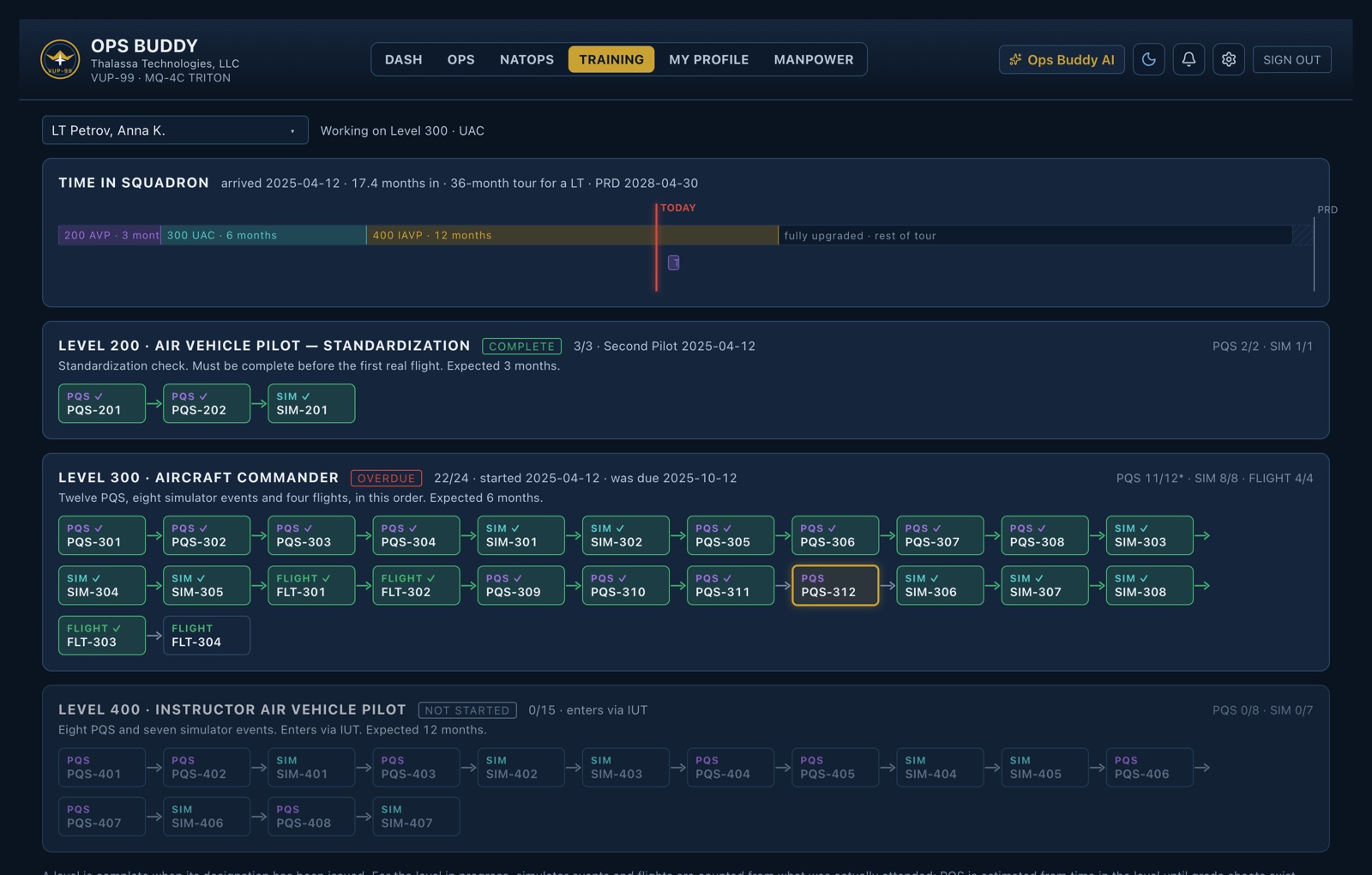
The training board for one aviator — time in the squadron as a bar, the upgrade syllabus as a flowchart with completed events marked off, and the projected date the next designation lands.
Demonstration data — fictional squadron, crews and aircraft
“Do my simulator hours count toward the check?”
Ask in plain language, get an answer from the source. The assistant reads the squadron’s own requirement settings and the governing instruction, answers the question that was actually asked, and cites where the answer came from so it can be checked.
OPS BUDDY
Thalassa Technologies, LLC
VUP-99 · MQ-4C TRITON
WHERE YOU STAND
NATOPS Check Flight short 34.4 hours, 7 approaches, 3 of them in the aircraft due in 60 days · 13 NOV 2026
Counting since 13 NOV 2025 — 65.6 hours (53.6 aircraft, 12 sim) · 5 approaches (3 in the aircraft) · 6 night.
✦Ops Buddy AI×
Do my simulator hours count toward the NATOPS check?
Yes, with a limit. Your command counts simulator hours toward the NATOPS Check Flight requirement, capped at 40% of the total — so at most 40 of the 100 hours.
You have logged 12 sim hours, so up to 28 more would still count. The approaches are different: 6 of the 12 must be flown in the aircraft, and you have 3.
Sources · Command Settings › Assumptions/Rules — “Simulator hours count toward the hours”, max share 0.4 · OPNAVINST 3710.7 ch. 8, simulator credit toward currency (paragraph cited in the command’s requirement record)
Ask about the board, or about NATOPS…
“What is happening right now?”
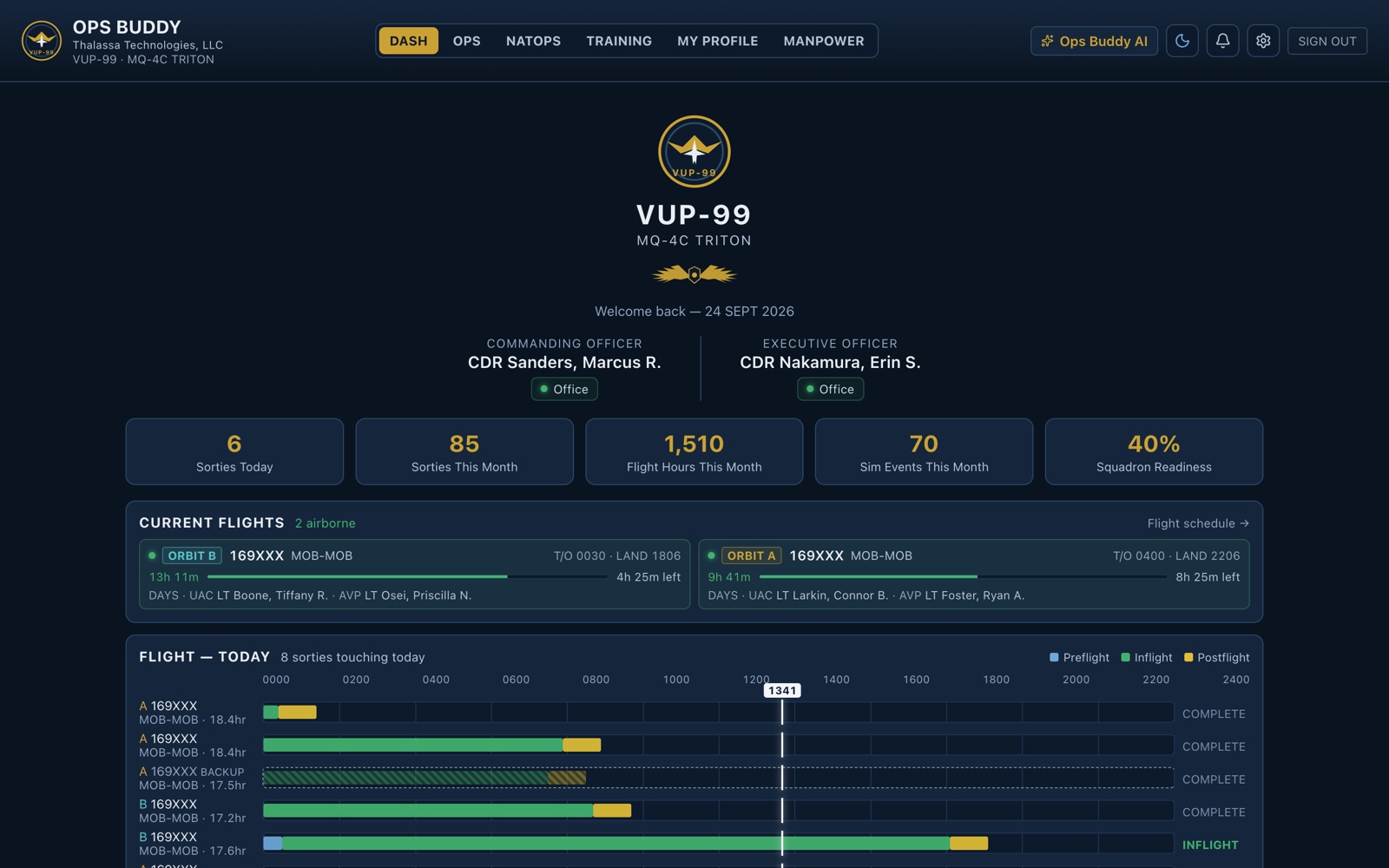
The dashboard on a real day: two aircraft airborne with time remaining, seven sorties on the timeline against a live clock, the simulators, ground events and the SDO feed — generated from the schedule, not typed.
Demonstration data — fictional squadron, crews and aircraft
Or follow the through-line
Follow one aviator from “due in 60 days” to a filed check.
This is the through-line. Every screen below is the application itself, in order, doing the parts of a NATOPS check that today live in a spreadsheet, an email, and somebody’s memory. Click a step, or use the arrows.
Step 1 of 16 · NATOPS › Matrix
The tracker says the check is due in 60 days
No one has to remember. The warning window is a command setting — 60 days by default — and the moment a NATOPS check crosses it the cell turns amber on the squadron matrix, the aviator’s row moves up, and an inbox notification goes out.
Demonstration data — fictional squadron, crews and aircraft
VUP-99 is not a real squadron and none of these people exist. The real MQ-4C squadrons are VUP-11 and VUP-19.
The Through-Line
A broken simulator is a small event. Its consequences are not.
The distance between “the sim went down” and “we missed an ORE milestone” is currently bridged by a person with a spreadsheet and several hours. Closing that gap automatically is what the product is for.
Automatic rescheduling
The rebuild is computed, not rebuilt by hand.
Hours returned
To the aircrew who were doing it manually.
Aviators trained faster
Syllabus and upgrades stop waiting on admin.
Higher readiness
FRTP, ARP and ORE milestones held, not chased.
Increased lethality
A squadron that can fight, which is the point.
Efficiency is the method. Readiness is the outcome. Tidier admin was never the goal.
The Problem
A squadron’s readiness picture lives in a dozen places at once.
Every one of them maintained by hand. It costs enormous manpower, it is fragile, and it is always slightly out of date. The people doing that work are aviators.
Fragmented
Qualifications in one spreadsheet. Schools in another. Sims, ground training, syllabus progress and TDY each in their own tracker. Nothing talks to anything else.
Manual
The schedule is magnet tiles on a whiteboard in operations. NATOPS jackets are paper. Currency is tracked by hand. Every change means finding and updating the same fact in five places.
Static
The picture is a snapshot, not a live state. By the time it is assembled, something has already changed.
Fragile
A missed expiration doesn’t surface until someone is already on the schedule. The check is a person remembering.
Reactive
Nobody can answer “what happens if” without rebuilding the plan by hand. So nobody asks, and problems are discovered instead of anticipated.
Inconsistent
Every platform has different requirements and every squadron has different assumptions. Generic tools can’t hold either, so squadrons build their own spreadsheets — again.
Where the hours actually go
The cost isn’t spread evenly. It concentrates in a handful of recurring, high-stakes events — and those are where the product has to win first.
- Fleet NATOPS Evaluations
- Unit NATOPS evaluations run on an 18-month cycle under CNAF M-3710.7, and the evaluator reviews unit records directly. Today that is done by hand, page by page, on both sides of the table. It is the single highest-leverage moment in the whole problem space.
- Daily scheduling and rescheduling
- Building tomorrow against quals, currency, medical status, crew rest and availability — reconciled by hand across trackers, every day. Then rebuilt every time something changes, which is daily.
- Readiness cycle planning
- FRTP, ARP and ORE milestones drive the long-range plan. The plan and the readiness cycle live in different documents, and keeping them aligned is manual work that never ends.
- Training and upgrade syllabus
- Syllabus progression and upgrade tracking sit in yet another tracker — disconnected from the schedule meant to advance them, and from the manning forecast that depends on them.
Security
Squadron readiness data is CUI. It is treated that way from day one.
The security posture is a design constraint, not something retrofitted after the fact. Ops Buddy is being built for a CUI-authorized cloud environment under Department of Defense security requirements, with credentialed access — so that accreditation is a review of existing design rather than a rewrite.
Current accreditation status
Ops Buddy is in active development and holds no security accreditation today. It is not currently CUI compliant, not FedRAMP authorized, and is not operating under an Authority to Operate. Nothing on this page claims or implies otherwise. Demonstrations run on synthetic data only.
Request a Demo
Request a demo.
A walkthrough runs about thirty minutes on demonstration data. Ops Buddy is built for the MQ-4C Triton community first and is customizable to any other platform in naval aviation — tell us yours and we will show you how it would fit.